
Posterior Auricular Lymph Nodes: Location, Causes of Swelling, and When to Worry
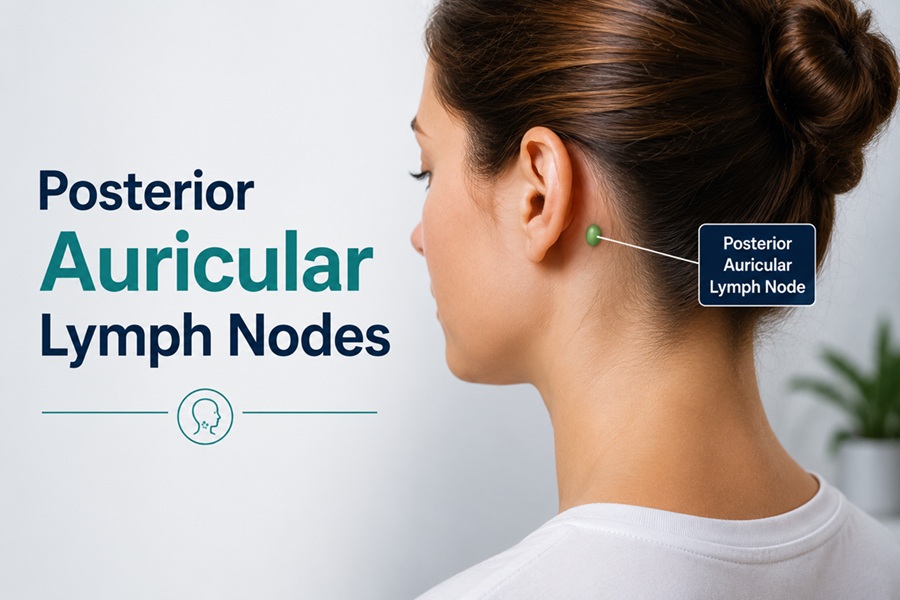
The posterior auricular lymph nodes are a small cluster of lymph nodes located directly behind the ear, sitting over the mastoid bone where the ear meets the skull. Usually there are only one to three of them on each side, and when healthy they are too small to feel. Their job is to filter lymph fluid draining from the scalp above and behind the ear, the outer ear itself, and the skin in that region. When you can feel a tender lump behind your ear, it is most often one of these nodes swelling in response to an infection nearby, such as a scalp infection, an ear infection, or in children, a viral illness like rubella.
The reassuring headline is that swollen posterior auricular nodes are usually a sign that your immune system is working, not a sign that something is seriously wrong. Most cases resolve on their own within a couple of weeks once the underlying infection clears. That said, a lump behind the ear that is hard, painless, steadily growing, or lasting more than two to four weeks deserves a doctor’s evaluation, because a small number of cases point to something that needs treatment.
| Feature | Details |
|---|---|
| Also called | Retroauricular or mastoid lymph nodes |
| Location | Behind the ear, over the mastoid process |
| Typical number | One to three per side |
| Normal size | Under 1 cm, usually not felt |
| Drains | Scalp behind and above ear, outer ear, nearby skin |
| Most common cause of swelling | Local infection (scalp, ear, skin) |
| Classic association | Rubella in children |
| Usual timeline | Resolves in 1 to 2 weeks |
| See a doctor if | Hard, fixed, painless, growing, or lasting over 2 to 4 weeks |
Where Exactly Are They?
If you place a finger just behind your earlobe and slide it upward along the bony ridge, you are in the right area. The posterior auricular nodes sit superficially, on top of the mastoid process, the bony bump you can feel behind the ear.
They belong to a wider network of head and neck lymph nodes, all of which drain different territories. Each group has its own catchment area, which is why swelling in one group points toward a problem in a specific region rather than the whole body.
| Node Group | Location | Drains |
|---|---|---|
| Posterior auricular | Behind the ear | Scalp behind ear, outer ear |
| Preauricular | In front of the ear | Eyelid, temple, front of ear |
| Occipital | Back of the skull | Back of scalp |
| Submandibular | Under the jaw | Mouth, tongue, face |
| Cervical | Sides of the neck | Throat, tonsils, wider head and neck |
This mapping is genuinely useful. If a node behind your ear is swollen, the cause is almost always in the area that node drains, meaning your scalp, your outer ear, or the skin right there. It is not a random event.
What Do They Do?
Lymph nodes are checkpoints. Lymph fluid carries cellular debris, bacteria, viruses, and other material away from your tissues, and it passes through nodes on its way back to the bloodstream.
Inside each node, immune cells inspect that fluid. When they detect something foreign, the node ramps up production of immune cells to fight it. That surge in activity is what makes the node swell and become tender. The swelling is the response, not the disease.
Common Causes of Swelling Behind the Ear
Scalp Infections
Because these nodes drain the scalp, anything irritating or infecting that skin can trigger them. Fungal infections like ringworm of the scalp, bacterial folliculitis, and infected cuts or insect bites are all common culprits.
Head Lice
This is one of the classic causes, especially in children. The scratching and skin irritation from lice frequently causes posterior auricular and occipital nodes to swell.
Ear Infections
Outer ear infections, including swimmer’s ear, sit squarely within this drainage territory. Middle ear infections can also cause nearby node reaction.
Skin Conditions
Severe dandruff, seborrheic dermatitis, eczema, and psoriasis on the scalp can all cause chronic low-grade node swelling from ongoing irritation.
Viral Infections
Rubella is the textbook association. Swollen posterior auricular and occipital nodes are a hallmark sign and often appear before the rash. Other viruses, including mononucleosis and general upper respiratory infections, can also cause swelling, though they usually affect multiple node groups.
Recent Piercings or Injuries
A new ear piercing, a scalp wound, or a minor injury in the area can cause a node to react while healing.
Swollen Node or Something Else?
Not every lump behind the ear is a lymph node, and knowing the difference helps. This table covers the most common possibilities.
| Lump Type | How It Tends to Feel |
|---|---|
| Reactive lymph node | Soft, mobile, tender, comes and goes |
| Sebaceous cyst | Smooth, rounded, moves under skin, often painless |
| Lipoma | Soft, doughy, slow-growing, painless |
| Mastoiditis | Firm, very tender, with redness and fever |
| Concerning node | Hard, fixed in place, painless, steadily growing |
Mastoiditis deserves a specific mention. It is an infection of the mastoid bone itself, usually following an untreated middle ear infection, and it needs prompt medical care. Redness, significant swelling, fever, ear pain, and a pushed-forward ear are the warning combination.
When Should You See a Doctor?
Most swollen nodes behind the ear need nothing but time. These signs, however, warrant an appointment:
The lump is hard and does not move when you press it. The lump is painless but steadily growing. It has lasted longer than two to four weeks without improving. You also have unexplained fever, night sweats, or weight loss. The skin over it is red, hot, and increasingly painful. You have hearing changes, drainage from the ear, or severe ear pain.
That combination of painless, hard, fixed, and persistent is the pattern doctors take most seriously, because it is less typical of simple infection. It does not mean something is wrong, but it does mean it should be looked at rather than watched indefinitely.
How Doctors Evaluate It
An evaluation usually starts simply. A doctor will feel the node to assess its size, firmness, and mobility, then examine your scalp, ears, and skin looking for the source. Often the cause turns up right there, an infected bite, a patch of fungal infection, an inflamed ear canal.
If the cause is not obvious or the node has features that concern them, they may order blood tests, imaging such as ultrasound, or in some cases a biopsy. Most people never reach that stage.
What You Can Do at Home
For a node that is clearly reacting to a minor infection, supportive care is usually enough. A warm compress can ease discomfort. Over-the-counter pain relief helps if it is tender. Treating the underlying cause, whether that is an antifungal shampoo for ringworm or lice treatment, is what actually resolves the swelling.
Resist the urge to squeeze or press the lump repeatedly. Constant prodding can prolong irritation and makes it harder to judge whether it is actually shrinking.
Common Questions
How long should a swollen node behind the ear last?
Usually one to two weeks once the underlying infection resolves. Some nodes stay slightly enlarged for several weeks afterward, which is normal. Anything persisting beyond four weeks should be checked.
Can stress cause swollen lymph nodes?
Not directly. Stress can weaken immune function and make infections more likely, but stress itself does not swell lymph nodes. There is almost always a physical trigger.
Are swollen posterior auricular nodes a sign of cancer?
Rarely. The overwhelming majority are reactive to infection. Cancer-related nodes tend to be hard, painless, fixed in place, and progressively enlarging, and are typically accompanied by other symptoms. This is why persistent, painless lumps get evaluated.
Why does my child have them so often?
Children’s immune systems encounter new infections constantly, and their nodes react readily. Frequent small, mobile, tender nodes in children are common and usually unremarkable.
Final Thoughts
The posterior auricular lymph nodes sit behind the ear and filter lymph from the scalp and outer ear. When they swell, they are almost always responding to something local and treatable: a scalp infection, an ear problem, lice, or a viral illness.
The practical takeaway is to look for the cause nearby, treat it, and give it time. But do not ignore a lump that is hard, painless, fixed, or growing over weeks. The cost of getting that checked is one appointment. The cost of ignoring it, in the rare case it matters, is far higher.